
Bone graft materials Periodontal treatment
Bone graft materials come from four sources: the patient's own bone (autograft), processed human donor bone (allograft), cattle or pig bone mineral (xenograft) and lab-made minerals (alloplast). In pooled biopsies, new bone made up 56% of the grafted area when the mix included the patient's own bone. Only autograft carries living bone-forming cells.

Where does bone graft material come from?
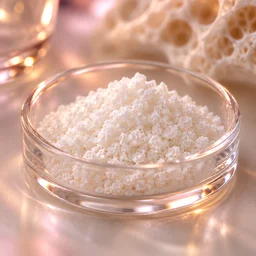
Bone graft material comes from the patient, a human donor, an animal or a laboratory. Autograft is the patient's own bone, taken from the jaw or chin for small grafts and from the hip or scalp when more is needed. Allograft is human bone from another person, such as a deceased donor, screened and processed by a tissue bank. Xenograft is bone mineral from cattle or pigs with all organic material removed. Alloplasts are made from hydroxyapatite, tricalcium phosphate, bioactive glass or polymers.
- Autograft: needs a second surgical site, and the supply is limited.
- Allograft, xenograft and alloplast: no second surgical site.
- Alloplast: wide availability, easy to shape and handle.
Materials are often combined. Bovine mineral, for example, is commonly mixed with particles or blocks of the patient's own bone. Bone grafting covers when a graft is needed, and ridge augmentation covers how grafts rebuild a thin jaw.
What do osteogenic, osteoinductive and osteoconductive mean?
Osteogenic, osteoinductive and osteoconductive name the three ways a graft helps new bone form. Osteogenic material contains living cells that can become bone. Osteoinductive material signals immature cells to develop into bone-forming cells. Osteoconductive material is a surface that bone grows onto from the bone around the defect.
| Material | Osteogenic | Osteoinductive | Osteoconductive |
|---|---|---|---|
| Autograft | Yes | Yes | Yes |
| Allograft | No | Yes | Yes |
| Xenograft | No | Debated | Yes |
| Alloplast | No | No | Yes |
Allograft carries type I collagen and bone morphogenetic proteins from the donor, the source of its inductive effect, and processing lowers some of its biological and mechanical properties. Some authors class bovine mineral such as Bio-Oss as osteoinductive, and others reserve the term for grafts with proteins or living material. Growth factors and the patient's own bone are added to animal or synthetic scaffolds to strengthen bone formation. PRF and growth factors lists the FDA-approved products.
Which bone graft material is best?
The patient's own bone is the reference material, and reviews find small or uncertain differences among the substitutes. Reviews call autograft the gold standard because it is osteogenic, osteoinductive and osteoconductive. Its drawbacks are the second surgical site and the limited supply.
- Sinus grafts: autogenous bone formed more new bone than synthetic or bovine material in the first months of healing.
- Long-term sinus results: implant loss did not differ between autogenous bone and bone substitutes.
- Ridge grafts: adding bovine mineral to the patient's own bone reduced graft shrinkage.
- Socket grafts: the Cochrane review found no clinically significant difference between materials.
A network meta-analysis of sinus biopsies concluded that substitute materials should be combined with the patient's own bone or an inductive graft for the best results. The choice of material also depends on defect size and shape, handling and the patient's health. Sinus lift types and socket preservation cover those sites in detail.
Is donor bone from a tissue bank safe?
Donor bone is regulated by the FDA as a human tissue product, and every donor must pass screening and laboratory tests. The rules are in 21 CFR Part 1271, which names bone as an example of a human cell and tissue product.
- Screening: a responsible person documents that the donor is free of risk factors for, and signs of, relevant infections.
- Testing: a donor specimen must test negative for HIV-1, HIV-2, hepatitis B, hepatitis C and Treponema pallidum (syphilis).
- Registration: tissue establishments register with the FDA and list each product they make.
- Scope: bone that is minimally manipulated, used for its original function and meets the other criteria of section 1271.10 is regulated under these tissue rules alone.
The AATB (Association for Advancing Tissue and Biologics) has accredited tissue banks since 1986. Accreditation follows an inspection by a team of qualified, independent assessors. Ask which tissue bank supplied your graft and whether it holds AATB accreditation. Questions to ask before surgery lists more.
Are cow and pig bone grafts safe?
Bovine and porcine graft materials are FDA-regulated dental devices, and the European periodontal guideline rates the risk of disease transmission from well-documented human or animal materials as extremely low. Under 21 CFR 872.3930, animal-source bone graft material and animal-source membranes are Class II devices. Graft products that contain a biologic drug, such as a growth factor, are Class III and need premarket approval.
Xenograft mineral has a calcium to phosphate ratio identical to that of human bone. Dissolvable membranes and the collagen sponge in the INFUSE growth factor kit also come from animal tissue. Religious concerns can arise because some regenerative materials are of porcine or bovine origin. Tell your periodontist before surgery if you want to avoid animal products, so a synthetic or human-derived option can be planned. Guided bone regeneration covers membrane types.
Questions
What is DFDBA in a bone graft?
DFDBA stands for demineralized freeze-dried bone allograft, a processed form of human donor bone. A systematic review found that DFDBA supports the formation of a new attachment apparatus in periodontal bone defects. Biologics such as enamel matrix derivative performed comparably to DFDBA in the AAP Regeneration Workshop review.
Can a bone graft be rejected?
Reviews list immune rejection and disease transmission as concerns with donor bone, and xenograft mineral has all organic components removed. The complications reported in socket grafting trials were delayed healing, pain, swelling, membrane exposure and partial loss of graft material, with no serious adverse events. Tell your periodontist about any past reaction to collagen or animal products.
Does a bone graft dissolve?
Graft material is a scaffold that the patient's own bone grows into. Lateral ridge grafts shrank by a pooled 1.13 mm of width as they healed, and grafts with bovine mineral alone lost less than mixtures of bovine mineral and autogenous bone. Synthetic beta-tricalcium phosphate was almost completely resorbed in an animal study.
Is synthetic bone graft as good as natural bone?
Synthetic grafts build bone by conduction only. In pooled ridge studies, synthetic particles gained 2.2 mm of width. Mixtures that included the patient's own bone gained 4.5 mm, a difference that was not statistically significant. In sinus grafts, synthetic material formed less new bone than autogenous bone during early healing.
What is the most common dental bone graft material?
Bovine xenograft dominates the graft market for the jaw and face, followed by synthetic materials, according to a review in the Journal of Clinical Periodontology. At Cambridge University Hospitals, the most commonly used graft is bovine bone mineral, often mixed with the patient's own bone. The most used membrane there is porcine.
Does taking my own bone leave a second wound?
Yes. Bone from the jaw or chin comes from a second site in the mouth, with risks of numbness of the lips and cheeks and a dimple in the chin. Hip grafts leave a scar of about 8 cm along the pant line and need an overnight hospital stay. About 4 weeks of rest come before exercise.
Sources
- Ferraz MP. Bone grafts in dental medicine: an overview of autografts, allografts and synthetic materials. Materials (Basel) 2023
- Albrektsson T, Johansson C. Osteoinduction, osteoconduction and osseointegration. Eur Spine J 2001
- Cambridge University Hospitals NHS Foundation Trust. Bone grafting for dental implants. Patient information 2024
- Troeltzsch M et al. Clinical efficacy of grafting materials in alveolar ridge augmentation: a systematic review. J Craniomaxillofac Surg 2016
- Al-Moraissi EA et al. Osteoconductive bone substitutes versus osteogenic and osteoinductive grafts for maxillary sinus augmentation: network meta-analysis. Int J Oral Maxillofac Surg 2020
- Raghoebar GM et al. Long-term effectiveness of maxillary sinus floor augmentation: a systematic review and meta-analysis. J Clin Periodontol 2019
- Naenni N et al. Efficacy of lateral bone augmentation prior to implant placement: a systematic review and meta-analysis. J Clin Periodontol 2019
- Atieh MA et al. Alveolar ridge preservation techniques for dental implant site development. Cochrane Database Syst Rev 2021
- Jensen SS, Terheyden H. Bone augmentation procedures in localized defects in the alveolar ridge. Int J Oral Maxillofac Implants 2009
- Elnayef B et al. The fate of lateral ridge augmentation: a systematic review and meta-analysis. Int J Oral Maxillofac Implants 2018
- eCFR. 21 CFR 1271.3, definitions for human cells, tissues and tissue-based products
- eCFR. 21 CFR 1271.10, tissue products regulated solely under section 361 of the PHS Act
- eCFR. 21 CFR 1271.50, determining donor eligibility
- eCFR. 21 CFR 1271.85, required donor testing
- AATB (Association for Advancing Tissue and Biologics). Accreditation program
- Sanz M et al. Treatment of stage I-III periodontitis: the EFP S3 level clinical practice guideline. J Clin Periodontol 2020
- eCFR. 21 CFR 872.3930, bone grafting material
- FDA Product Classification database. Regulation 872.3930 product codes and device classes
- FDA. Summary of Safety and Effectiveness Data, PMA P050053, INFUSE Bone Graft. 2007
- Haugen HJ et al. Bone grafts: which is the ideal biomaterial? J Clin Periodontol 2019
- Reynolds MA et al. The efficacy of bone replacement grafts in the treatment of periodontal osseous defects: a systematic review. Ann Periodontol 2003
- Kao RT et al. Periodontal regeneration, intrabony defects: a systematic review from the AAP Regeneration Workshop. J Periodontol 2015
Bone grafting Read next
 Sinus lift types: lateral window and crestalA lateral window sinus lift reaches the sinus floor through a small window in the side of the upper jaw, and a crestal (osteotome) lift raises the floor through the implant hole from below.
 Bone graft recovery day by dayRecovery from a dental bone graft comes in stages: the gum heals over 1 to 3 weeks, and the graft then matures into bone over months before an implant.
 Periodontal regenerationPeriodontal regeneration regrows the bone, ligament and root cementum that hold a tooth, in deep bone defects beside a root (intrabony defects) and between the roots of molars (furcations).
 Bone graftingA dental bone graft adds bone or a bone substitute where the jaw is too thin or short for an implant, or fills a socket after extraction to keep its shape.Socket preservation after extractionSocket preservation places bone graft material in a tooth socket at the extraction visit, usually under a collagen membrane or sponge, to limit shrinking of the jaw ridge as it heals.Ridge augmentationRidge augmentation rebuilds a jaw ridge that is too thin or too short for an implant, adding width (horizontal) or height (vertical) with particulate grafts under a membrane, bone blocks, ridge splitting or tenting screws.