
Who can get dental implants Periodontal treatment
Most adults with healthy gums, enough jawbone and controlled medical conditions can get dental implants. In a meta-analysis, 6.35% of implants placed in smokers failed. The rate in non-smokers was 3.18%. AAOMS advises against implants for cancer patients receiving antiresorptive injections or infusions or antiangiogenic medicines.

Who is a good candidate for dental implants?
A good candidate for dental implants has healthy gums free of periodontal disease and enough jawbone to hold the implant, according to the American Academy of Periodontology. Cleveland Clinic lists conditions that can make implants a poor option: active or untreated gum disease, bone disorders and some autoimmune diseases, extensive tooth decay, poor oral hygiene, severe bone loss in the jaw and unmanaged diabetes. Ask your periodontist which of these can be treated before surgery.
Older age is not a barrier in the evidence. A meta-analysis of implant patients aged 75 or older found implants a predictable treatment option. Implant survival in that group was 96.1% after five years. Short implants of 6 mm or less are a valid option where bone height is reduced, according to an ITI consensus report. The same report linked certain antidepressants and acid-reflux drugs to higher implant failure. Implants after gum disease and bone grafting cover these fixes.
Can you get dental implants if you have diabetes?
People with well-controlled diabetes get implants with success rates similar to people without diabetes. An updated systematic review found no contraindication to implant surgery in diabetes or prediabetes under controlled conditions. Patients with poorly controlled diabetes had more peri-implantitis and higher implant loss over the long term in the same review.
HbA1c, the blood test for long-term sugar control, is the measure the studies use. Patients with HbA1c under 8% had high short-term implant survival in one review. Above that level, osseointegration progressed at a slower rate. Another meta-analysis linked each 1% rise in HbA1c to extra crestal bone loss. That added loss was 0.24 mm. Its authors advise measuring HbA1c when planning implants, so that undiagnosed or poorly controlled diabetes is found before surgery. Gum treatment and diabetes affect each other, as covered in gum disease and overall health.
Can smokers get dental implants?
Smokers can get dental implants, with a higher risk of failure. A meta-analysis found failure in 6.35% of implants placed in smokers. Failure among implants in non-smokers was 3.18%. Smokers also had more postoperative infections and more bone loss around implants. A later, larger meta-analysis estimated a 140.2% higher failure risk for smokers.
Stopping helps. In a prospective study, smokers who followed a smoking cessation protocol around implant placement showed no significant difference in failure rates from non-smokers. Smokers who kept smoking failed significantly more often. Guy's and St Thomas' NHS Foundation Trust strongly recommends stopping smoking and staying a non-smoker in the long term to lower the risk of implant complications. Ask about stop-smoking support before surgery is booked. Smoking is also a risk factor for gum disease, covered in does smoking cause gum disease, and the rules for smoking after surgery are in implant recovery.
Can you get implants if you take bisphosphonates?
Most people taking bisphosphonates for osteoporosis can get implants after informed consent about a low risk of jaw osteonecrosis. The AAOMS position paper estimates the risk of medication-related osteonecrosis of the jaw (MRONJ) at 0.05% or less with oral bisphosphonates. An ITI consensus found no increase in implant failure with bisphosphonates taken for osteoporosis. A meta-analysis pooled a 0.5% rate of MRONJ after implants in people on antiresorptive drugs for osteoporosis. AAOMS asks for consent that covers MRONJ and early and late implant failure, followed by a long-term recall schedule.
Cancer patients face a different rule. AAOMS states that implants should be avoided in cancer patients receiving antiresorptive injections or infusions or antiangiogenic medicines. Among cancer patients on zoledronate, the risk of MRONJ clusters below 5%. Osteoporosis itself did not lower implant survival in a meta-analysis, though bone loss around the implants was greater. Bring a list of bone medicines and their start dates to the first visit.
Can you get dental implants after radiation therapy?
Implants can be placed after head and neck radiation, with a higher failure risk. A systematic review found a risk ratio of 2.74 for implant failure in irradiated patients. Upper-jaw sites carried a risk ratio of 5.96 in the same review. Hyperbaric oxygen therapy did not reduce implant failure in that analysis. The authors still judged implants a viable option for restoring chewing in irradiated patients.
A second meta-analysis found no significant survival difference between implants placed before or after 12 months following radiotherapy. It found a tendency toward lower survival with higher radiation doses. It also failed to support hyperbaric oxygen for irradiated implant patients. Ask the cancer care team and the periodontist to plan the timing together, and consider a second opinion for complex cases. Other options are compared in implant vs bridge vs denture.
Questions
Is there an age limit for dental implants?
Cleveland Clinic gives 18 as the typical minimum age and sets no upper limit, since jaw growth must be complete first. A systematic review of implants placed in growing jaws found implants sitting below the bite in the upper jaw and rotating in the lower jaw as growth continued. That review advised implants in growing patients only under special circumstances.
Can you get implants if you lost teeth to gum disease?
Implants are placed for people who lost teeth to periodontitis once the disease is treated. A meta-analysis found a risk ratio of 1.69 for implant loss in patients with periodontitis. Their risk ratio for peri-implantitis was 2.17. The 2017 World Workshop found strong evidence that a history of chronic periodontitis, poor plaque control and no regular maintenance raise peri-implantitis risk.
Do I need to stop bisphosphonates before implant surgery?
AAOMS calls drug holidays controversial. For people on antiresorptive therapy for conditions other than cancer, its prevention table advises no change to the operative plan for most patients. For osteoporosis patients, AAOMS states that elective dentoalveolar surgery does not appear to be contraindicated in general. Do not stop a bone medicine without the prescribing physician.
Do antidepressants or acid reflux medicines affect dental implants?
Two drug groups were linked to more implant failures in a systematic review: selective serotonin reuptake inhibitors, a class of antidepressants, and proton pump inhibitors for acid reflux. The review found a 4.3% difference in failure rates with proton pump inhibitors. The difference was 7.5% with the antidepressants. Do not stop a prescribed medicine for an implant; list every medicine for the periodontist.
Can you get dental implants with an autoimmune disease?
Cleveland Clinic cites a study showing comparable implant success rates in people with and without autoimmune diseases. Some of these diseases cause dental problems that make implants harder, and some of their medicines raise the risk of complications during healing. The periodontist reviews the medical history and every medicine before planning the implant.
Sources
- American Academy of Periodontology. Dental implant procedures
- Cleveland Clinic. Dental implants. Health Library 2026
- Schimmel M et al. Effect of advanced age and/or systemic medical conditions on dental implant survival: a systematic review and meta-analysis. Clin Oral Implants Res 2018
- Jung RE et al. Group 1 ITI Consensus Report: the influence of implant length and design and medications on clinical and patient-reported outcomes. Clin Oral Implants Res 2018
- Chappuis V et al. Medication-related dental implant failure: systematic review and meta-analysis. Clin Oral Implants Res 2018
- Wagner J et al. Systematic review on diabetes mellitus and dental implants: an update. Int J Implant Dent 2022
- Tan SJ et al. Does glycemic control have a dose-response relationship with implant outcomes? A comprehensive systematic review and meta-analysis. J Evid Based Dent Pract 2021
- Bencze B et al. Prediabetes and poorly controlled type-2 diabetes as risk indicators for peri-implant diseases: a systematic review and meta-analysis. J Dent 2024
- Chrcanovic BR, Albrektsson T, Wennerberg A. Smoking and dental implants: a systematic review and meta-analysis. J Dent 2015
- Mustapha AD, Salame Z, Chrcanovic BR. Smoking and dental implants: a systematic review and meta-analysis. Medicina (Kaunas) 2021
- Bain CA. Smoking and implant failure: benefits of a smoking cessation protocol. Int J Oral Maxillofac Implants 1996
- Guy's and St Thomas' NHS Foundation Trust. Dental implants: overview
- Ruggiero SL et al. American Association of Oral and Maxillofacial Surgeons position paper on medication-related osteonecrosis of the jaws, 2022 update. J Oral Maxillofac Surg 2022
- Mirza R et al. Dental implant failure and medication-related osteonecrosis of the jaw related to dental implants in patients taking antiresorptive therapy for osteoporosis: a systematic review and meta-analysis. Endocr Pract 2025
- Lemos CAA et al. Do dental implants placed in patients with osteoporosis have higher risks of failure and marginal bone loss compared to those in healthy patients? A systematic review with meta-analysis. Clin Oral Investig 2023
- Chambrone L et al. Dental implants installed in irradiated jaws: a systematic review. J Dent Res 2013
- Chrcanovic BR, Albrektsson T, Wennerberg A. Dental implants in irradiated versus nonirradiated patients: a meta-analysis. Head Neck 2016
- Bohner L et al. Dental implants in growing patients: a systematic review. Br J Oral Maxillofac Surg 2019
- Sgolastra F et al. Periodontitis, implant loss and peri-implantitis: a meta-analysis. Clin Oral Implants Res 2015
- Schwarz F et al. Peri-implantitis. 2017 World Workshop review. J Clin Periodontol 2018
Dental implants Read next
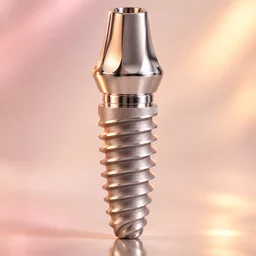 Dental implantsA dental implant is a titanium or zirconia post placed in the jawbone to replace a tooth root.Immediate implants and same-day teethImmediate implants go into the socket on the day a tooth is removed, and immediate loading attaches a tooth to an implant within a week of surgery.
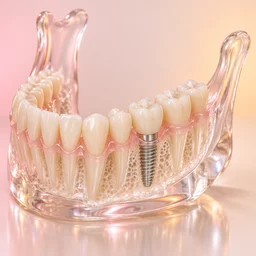 Full-arch implants and implant denturesFull-arch implants replace every tooth in a jaw with either a bridge fixed to implants or a denture that snaps onto them.
 Guided implant surgeryGuided implant surgery plans each implant on a 3D CBCT scan and transfers the plan to the mouth with a printed guide, live navigation or a robot arm.Implant vs bridge vs dentureDental implants, bridges and dentures all replace missing teeth; they differ in surgery, effect on the neighboring teeth, upkeep and time to finish.
 Recovery after dental implant surgeryRecovery after dental implant surgery takes about a week for the gum and several months for the bone.