
Dental implant process and timeline Periodontal treatment
The dental implant process runs from a consultation and 3D CBCT scan, through implant surgery and bone healing, to the abutment and final crown. Guy's and St Thomas' NHS Foundation Trust tells patients that treatment can take 6 to 12 months in total. Extractions and bone grafts add healing stages; an implant placed at the extraction visit removes one.

Step by step
- Consultation with an exam, medical history, X-rays and a 3D CBCT scan of the jaw.
- Extraction of the failing tooth, often with a bone graft in the socket.
- Healing of any bone graft or sinus lift before the implant goes in.
- Implant surgery under local anesthetic: the gum is lifted, the site drilled, the implant placed and the gum stitched.
- Healing while the bone bonds to the implant (osseointegration).
- Uncovering of a buried implant and fitting of the abutment.
- Scans or moulds, then the final crown, bridge or denture.
- Maintenance visits with probing and X-rays.
How long does the dental implant process take?
Dental implant treatment takes about 6 to 12 months from the first visit to the final teeth, according to the patient guide of Guy's and St Thomas' NHS Foundation Trust. Most of that time is bone healing. A Cochrane review describes the conventional protocol as keeping implants free of load for 3 to 8 months while bone forms around them. Cleveland Clinic gives 3 to 9 months for the jawbone to fuse to the implant. The NHS guide adds 4 to 6 months when a bone graft comes first.
The total depends on whether a tooth must come out, whether the jaw needs a graft, and how soon a tooth goes onto the implant. An implant placed on the day of the extraction skips the wait for the socket to heal. A tooth attached within a week of surgery is called immediate loading. Immediate implants shorten treatment; waiting after a bone graft lengthens it.
What happens at each stage of getting an implant?
Each stage of implant treatment has its own visits and its own healing time. Guy's and St Thomas' describes several planning visits for X-rays and moulds before surgery. Some stages share a visit: an implant can go in at the extraction, and a small graft can go in with the implant.
| Stage | What happens | Typical time |
|---|---|---|
| Planning | Exam, X-rays, CBCT scan, moulds or digital scans | Several visits |
| Extraction and socket graft | Tooth removed; graft material fills the socket | Graft heals for at least 3 months |
| Implant surgery | Gum lifted, site drilled, implant placed, gum stitched | Stitches out after about a week |
| Bone healing | Bone bonds to the implant (osseointegration) | At least 3 months before teeth |
| Uncovering | Second small procedure for an implant buried under the gum | After healing |
| Abutment and crown | Connector and final tooth attached | About 1 hour to fit |
A sinus lift or bone graft adds its own healing stage before the implant when bone is short.
Why is a CBCT scan needed for an implant?
A CBCT scan shows the jawbone in three dimensions, so the implant's length, width and angle can be planned around nerves, tooth roots and the sinus. The American Academy of Oral and Maxillofacial Radiology recommends cross-sectional imaging for every dental implant site and names CBCT the imaging method of choice. The FDA summary for one implant guidance system describes placing a virtual implant on the CT scan to avoid critical anatomical structures.
Radiation dose depends on the machine and its settings. A review of CBCT in implant dentistry found doses equal to 2 to 200 panoramic radiographs, even for similar indications. Patient movement and metal artefacts can also lower image quality, according to the same review. The 3D data can feed planning software, printed surgical guides and the navigation systems used in guided implant surgery. Bring any recent X-rays or scans to the first visit.
How long after extraction can you get an implant?
An implant can go in on the day of the extraction, after the gum over the socket heals, or after the socket fills with bone. A Cochrane review calls these immediate, immediate-delayed and delayed implants. In the early placement protocol studied by Buser and colleagues, the implant goes in after 4 to 8 weeks of soft tissue healing. A meta-analysis of single implants counted placement 3 months or more after extraction as delayed.
The ridge shrinks while the socket heals. Re-entry studies measured the ridge six months after extraction. By then its width had fallen by 29% to 63%. Most of that change happened in the first months. A graft placed at extraction, called socket preservation, may limit the loss, though a Cochrane review rated that evidence very uncertain. Immediate implants avoid the separate healing wait.
What happens after the implant heals?
After the implant heals, the restoring dentist attaches the abutment and the final crown, bridge or denture. Making the replacement teeth takes several appointments for moulds and fit checks, according to Guy's and St Thomas'. Cleveland Clinic states that attaching the abutment and final restoration usually takes about one hour and may need a second minor surgery. The restoration is either cemented or screwed to the implant.
The 2017 World Workshop on peri-implant diseases recommends baseline X-rays and probing measurements once the implant prosthesis is complete. Those records are the reference for every later check for peri-implantitis. The workshop also found limited evidence linking peri-implantitis to cement left under the gum after the crown is fitted. Regular maintenance visits then monitor the implant, the teeth and the gums.
Questions
How many appointments does a dental implant take?
Guy's and St Thomas' NHS Foundation Trust describes implant treatment in 3 or 4 stages: a pre-operative assessment, bone grafting when needed, putting in the implant, and fitting the crown, bridge or denture. Each stage might involve several visits. Bone grafting is the stage not every patient needs. Ask the office for the full visit schedule before surgery.
Do you always need a bone graft for a dental implant?
A bone graft is needed only when the jaw lacks the height or width to hold the implant. The American Academy of Periodontology names the quantity and quality of bone as a key to implant success. An ITI consensus report lists short implants of 6 mm or less as a valid option where bone height is reduced, with more variable survival than standard lengths.
Will I have a gap while the implant heals?
A temporary tooth usually covers the gap for an implant near the front of the mouth, according to Cleveland Clinic. An implant near the back of the mouth may not need a temporary tooth. Denture wearers might not be able to wear the denture for up to 2 weeks after implant surgery, according to Guy's and St Thomas'.
What is the difference between one-stage and two-stage implant surgery?
In one-stage surgery the implant sticks out through the gum while the bone heals. In two-stage surgery the implant is buried under the gum and needs a second small procedure to uncover it before the replacement teeth are made. Guy's and St Thomas' describes both approaches. The periodontist chooses the approach for each implant site.
Can the dental implant process be done in one day?
Some patients receive implants and teeth on the same day, a protocol called immediate placement with immediate loading. In a systematic review of All-on-4 studies, full-arch bridges were fitted within 48 hours of surgery. A review of single front-tooth cases found high survival for this protocol in studies with strict patient and site selection criteria.
Is the dental implant process painful?
Implant surgery is done under anesthesia, and Cleveland Clinic states that patients should not feel pain during the procedure. Slight discomfort and swelling afterward are normal. Over-the-counter pain relievers usually ease them, and most people feel like themselves within about a week, according to the same source.
Sources
- Guy's and St Thomas' NHS Foundation Trust. Dental implants: overview
- Guy's and St Thomas' NHS Foundation Trust. Having a dental implant
- Guy's and St Thomas' NHS Foundation Trust. After having a dental implant
- Esposito M et al. Interventions for replacing missing teeth: different times for loading dental implants. Cochrane Database Syst Rev 2013
- Cleveland Clinic. Dental implants. Health Library 2026
- Cleveland Clinic. Dental bone graft. Health Library 2024
- Tyndall DA et al. Position statement of the American Academy of Oral and Maxillofacial Radiology on selection criteria for the use of radiology in dental implantology with emphasis on cone beam computed tomography. Oral Surg Oral Med Oral Pathol Oral Radiol 2012
- FDA 510(k) summary K161399, Neocis Guidance System
- Jacobs R et al. Cone beam computed tomography in implant dentistry: recommendations for clinical use. BMC Oral Health 2018
- Esposito M et al. Interventions for replacing missing teeth: dental implants in fresh extraction sockets (immediate, immediate-delayed and delayed implants). Cochrane Database Syst Rev 2010
- Buser D et al. Early implant placement with simultaneous guided bone regeneration following single-tooth extraction in the esthetic zone: 12-month results of a prospective study. J Periodontol 2009
- Cosyn J et al. The effectiveness of immediate implant placement for single tooth replacement compared to delayed implant placement: a systematic review and meta-analysis. J Clin Periodontol 2019
- Tan WL et al. A systematic review of post-extractional alveolar hard and soft tissue dimensional changes in humans. Clin Oral Implants Res 2012
- Atieh MA et al. Interventions for replacing missing teeth: alveolar ridge preservation techniques for dental implant site development. Cochrane Database Syst Rev 2021
- Pjetursson BE et al. Improvements in implant dentistry over the last decade: comparison of survival and complication rates in older and newer publications. Int J Oral Maxillofac Implants 2014
- Berglundh T et al. Peri-implant diseases and conditions: consensus report of workgroup 4 of the 2017 World Workshop. J Clin Periodontol 2018
- Schwarz F et al. Peri-implantitis. 2017 World Workshop review. J Clin Periodontol 2018
- American Academy of Periodontology. Dental implant procedures
- Jung RE et al. Group 1 ITI Consensus Report: the influence of implant length and design and medications on clinical and patient-reported outcomes. Clin Oral Implants Res 2018
- Patzelt SB et al. The all-on-four treatment concept: a systematic review. Clin Implant Dent Relat Res 2014
- Hamilton A et al. Selection criteria for immediate implant placement and immediate loading for single tooth replacement in the maxillary esthetic zone: a systematic review and meta-analysis. Clin Oral Implants Res 2023
Dental implants Read next
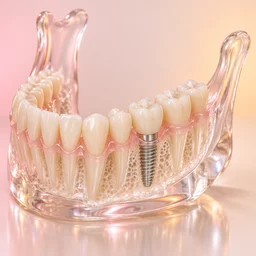 Full-arch implants and implant denturesFull-arch implants replace every tooth in a jaw with either a bridge fixed to implants or a denture that snaps onto them.
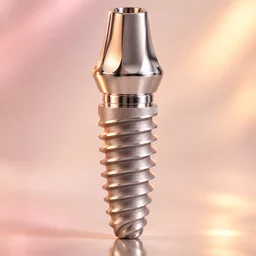 Zirconia vs titanium implantsTitanium and zirconia implants both bond to the jawbone; titanium has the longer research record and zirconia is the ceramic option.
 Who can get dental implantsMost adults with healthy gums, enough jawbone and controlled medical conditions can get dental implants.How long dental implants lastDental implants usually last decades when the gum and bone around them stay healthy.Implant vs bridge vs dentureDental implants, bridges and dentures all replace missing teeth; they differ in surgery, effect on the neighboring teeth, upkeep and time to finish.Mini dental implantsMini dental implants are narrow implants, usually in one piece, used mostly to hold a denture in place when the jaw is too thin for standard implants.