
Zirconia vs titanium implants Periodontal treatment
Titanium and zirconia implants both bond to the jawbone; titanium has the longer research record and zirconia is the ceramic option. A meta-analysis of commercially available zirconia implants found 97.2% survival after five years of loading. Most zirconia evidence covers one-piece implants, and confirmed titanium allergy is rare.

What are titanium dental implants made of?
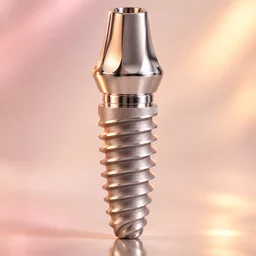
Titanium dental implants are made of unalloyed titanium or a titanium alloy. The federal rule for endosseous dental implants describes them as made of a material such as titanium or titanium alloy. FDA guidance for implant submissions names unalloyed titanium under the ASTM F67 standard. The same guidance names two alloys: titanium with aluminum and vanadium (ASTM F136) and titanium with aluminum and niobium (ASTM F1295).
ASTM F67 covers four grades of unalloyed titanium, from Grade 1 to Grade 4. Some narrow implants use a titanium-zirconium alloy, which a systematic review describes as having higher tensile strength than commercially pure titanium. Cleveland Clinic states that most implants are titanium and some are ceramic, and that both materials are safe and biocompatible. Narrow designs are covered under mini dental implants, and the implant itself under dental implants.
How do one-piece and two-piece zirconia implants differ?
A one-piece zirconia implant has the abutment built in; a two-piece zirconia implant takes a separate abutment held by a screw. The FDA summary for the Straumann PURE Ceramic Implant describes a one-piece monotype implant made of yttrium-stabilized zirconia with no internal connection. The FDA summary for the Zeramex XT system describes two-piece implants of aluminum-toughened zirconia with screw-retained abutments and carbon-fiber-reinforced PEEK screws.
Evidence differs by design. The 2018 ITI consensus states that one-piece zirconia implants can be recommended when appropriate clinical conditions exist. The same consensus advises using two-piece zirconia implants with caution because of insufficient data. A 2023 review of ceramic implants found scientific evidence for two-piece designs rare. Most studies in a zirconia meta-analysis covered one-piece implants. Ask your periodontist which design the office uses and what evidence supports it. Who can get implants covers the health checks that come first.
Do zirconia implants last as long as titanium?
Zirconia implants show survival similar to titanium in short-term and medium-term studies, with less long-term data. A meta-analysis of commercially available zirconia implants estimated 98.3% survival after one year. The same analysis estimated 97.2% after two years. Its authors found these results similar to published data for titanium implants and called for more long-term studies.
A later meta-analysis limited to studies with five years of loading found 97.2% survival for commercial zirconia implants. Mean bone loss around them after five years was 1.1 mm. For titanium, a systematic review of contemporary implant systems found 96.4% survival after ten years. Survival of commercially available zirconia implants improved significantly over non-commercial designs since 2004. Check whether a zirconia study used a commercially available implant. How long implants last covers titanium survival and the causes of late failure.
Can you be allergic to titanium dental implants?
Titanium allergy is possible and rare. A clinic study of 1,500 implant patients selected those with allergy symptoms or risk factors for skin testing. Positive titanium allergy tests were found in 0.6% of all the patients. Half of the patients with allergy-compatible symptoms after implant placement tested positive. The authors write that allergy tests could be recommended for patients who show an allergy-compatible response after surgery.
A systematic review concluded that the significance of titanium as a cause of allergic reactions in implant patients remains unproven. The tests used in those studies include the patch test, the memory lymphocyte immunostimulation assay and lymphocyte transformation tests. Tell the periodontist about any metal allergy before the implant is planned. Allergy is one of several health questions reviewed under implant candidates, alongside gum disease.
Are zirconia implants FDA approved?
Zirconia implants are FDA-cleared through the 510(k) premarket route used for titanium implants. FDA classifies root-form endosseous dental implants as class II devices with special controls. A 510(k) clearance means FDA found the device substantially equivalent to a legally marketed device. Nobel Biocare's Zirconia Implant, made of yttria-stabilized zirconium oxide with an integrated abutment, received that finding in 2007.
Straumann's one-piece PURE Ceramic Implants were found substantially equivalent in 2016. The two-piece Zeramex XT and NobelPearl systems received the same finding in 2018. FDA's 2024 performance-criteria guidance for implants lists only titanium materials. A clearance covers the device for the indications for use stated in its file. Each FDA record can be searched by its 510(k) number in the FDA database. Implants of either material need the same maintenance to prevent peri-implantitis.
Questions
Is zirconia a metal?
Zirconia is zirconium oxide, a ceramic. The FDA summary for one zirconia implant describes it as yttria-stabilized zirconium oxide. Another FDA-cleared system uses aluminum-toughened zirconia. Cleveland Clinic groups these implants as ceramic and states that both titanium and ceramic implants are safe and biocompatible.
What are the symptoms of a titanium implant allergy?
Reported reactions include skin rashes, inflamed skin, overgrowth of the gum, swelling in the chin and lip area and redness of the soft tissue. A clinic study listed symptoms ranging from skin rashes and implant failure to non-specific immune suppression. A systematic review found the role of titanium in these reactions unproven. Ask the periodontist about allergy testing when symptoms start after implant surgery.
Do zirconia implants break?
Fracture is uncommon in current zirconia implants. A meta-analysis reported implant fractures in 0.2% of commercially available zirconia implants. A 2023 review of ceramic implants rated the risk of implant fracture low for current commercial designs. Ask which brand and design is proposed, and how long it has been on the market.
Do zirconia implants lose more bone than titanium?
Bone loss around commercial zirconia implants is similar to published data for titanium in short-term studies. A meta-analysis estimated a mean bone loss of 0.7 mm in the first year. A ceramic implant review found that one-piece designs achieve osseointegration similar to titanium implants. The meta-analysis authors called for more long-term clinical data.
Can zirconia implants be placed the same day as an extraction?
Some zirconia implants are cleared for immediate placement. The FDA summary for Nobel Biocare's Zirconia Implant states that it may be placed immediately and put into immediate function when the initial stability requirements are met. A ceramic implant review found that immediate loading or temporization did not interfere with osseointegration. Ask your periodontist whether the planned zirconia design is cleared for immediate placement.
Sources
- 21 CFR 872.3640, Endosseous dental implant. Electronic Code of Federal Regulations
- FDA. Endosseous dental implants and endosseous dental implant abutments: performance criteria for safety and performance based pathway. Guidance 2024
- ASTM F67. Standard specification for unalloyed titanium, for surgical implant applications
- Altuna P et al. Clinical evidence on titanium-zirconium dental implants: a systematic review and meta-analysis. Int J Oral Maxillofac Surg 2016
- Cleveland Clinic. Dental implants. Health Library 2026
- FDA 510(k) K151328, PURE Ceramic Implants, Straumann USA, decided 2016-01-11
- FDA 510(k) summary K151328, Straumann PURE Ceramic Implants
- FDA 510(k) K180184, Zeramex XT and NobelPearl Dental Implant Systems, Dentalpoint AG, decided 2018-11-16
- FDA 510(k) summary K180184, Zeramex XT and NobelPearl Dental Implant Systems
- FDA 510(k) K061971, Zirconia Implant, Nobel Biocare AB, decided 2007-03-06
- FDA 510(k) summary K061971, Nobel Biocare Zirconia Implant
- Morton D et al. Group 2 ITI Consensus Report: prosthodontics and implant dentistry. Clin Oral Implants Res 2018
- Neugebauer J et al. Ceramic dental implants: a systematic review and meta-analysis. Int J Oral Maxillofac Implants 2023
- Roehling S et al. Performance and outcome of zirconia dental implants in clinical studies: a meta-analysis. Clin Oral Implants Res 2018
- Roehling S et al. Clinical and radiographic outcomes of zirconia dental implants: a systematic review and meta-analysis. Clin Oral Implants Res 2023
- Howe MS, Keys W, Richards D. Long-term (10-year) dental implant survival: a systematic review and sensitivity meta-analysis. J Dent 2019
- Sicilia A et al. Titanium allergy in dental implant patients: a clinical study on 1500 consecutive patients. Clin Oral Implants Res 2008
- Javed F et al. Is titanium sensitivity associated with allergic reactions in patients with dental implants? A systematic review. Clin Implant Dent Relat Res 2013
Zirconia vs titanium implants In Florida
Practices whose own website has a page for this treatment. Each name opens the practice record.
Southeast
Tampa Bay
Central
Southwest
Dental implants Read next
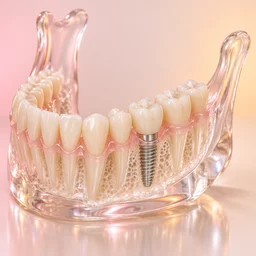
 Dental implant process and timelineThe dental implant process runs from a consultation and 3D CBCT scan, through implant surgery and bone healing, to the abutment and final crown.
 Full-arch implants and implant denturesFull-arch implants replace every tooth in a jaw with either a bridge fixed to implants or a denture that snaps onto them.
 Guided implant surgeryGuided implant surgery plans each implant on a 3D CBCT scan and transfers the plan to the mouth with a printed guide, live navigation or a robot arm.Implant vs bridge vs dentureDental implants, bridges and dentures all replace missing teeth; they differ in surgery, effect on the neighboring teeth, upkeep and time to finish.
 Recovery after dental implant surgeryRecovery after dental implant surgery takes about a week for the gum and several months for the bone.Dental implantsA dental implant is a titanium or zirconia post placed in the jawbone to replace a tooth root.